






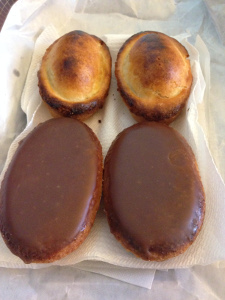


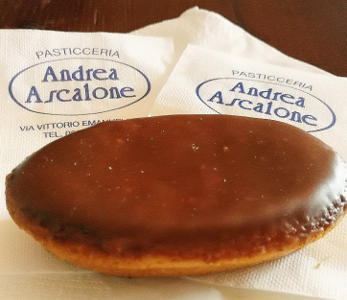
The sweeter side of Salento is represented by exquisite small caskets of pastry from the sumptuous flavor that refers to the baroque of the historical centers of some towns. They are called pasticciotti and fruttoni and in these dessert by typical oval shape coexist at least two souls of the Salento gastronomy: the simple and straightforward of the custard and the Arab influence of the soft cream of white almonds with a heart of quince or pear jam and a cover of dark chocolate.
Today are considered the Salento typical sweets, to eat especially in the morning at breakfast, but excellent in all times of the day. But what is their origin? The birth of pasticciotto goes back at the beginning of the eighteenth century, when it was mentioned for a first time in Nardò in the inventory of the bishop Mons. Orazio Fortunato, which reads: “Copper barchiglie to make pasticciotto […]». At the time the desserts consist of varchiglia or barchiglia, that a small boat of shortbread which often contained a filling of flour and almonds and often covered in chocolate, were called “bucconotti”. Next, the recipe was modified and stuffed with almond flour was replaced with the grape homemade jam, while the top is covered with chocolate or icing sugar. The link between bocconotto and varchiglia finds himself, going back in time, already in Cosenza in 1300, where the Carmelite nuns prepared this dessert for the tables of bishops.
Moreover bocconotti are typical desserts of Puglia, Basilicata, Abruzzo and Calabria with a filling that varies according to the location where it is produced. The well-known “bocconotto of Bitonto”, prepared by Benedictine nuns, where the recipe calls for a filling of ricotta and sugar.
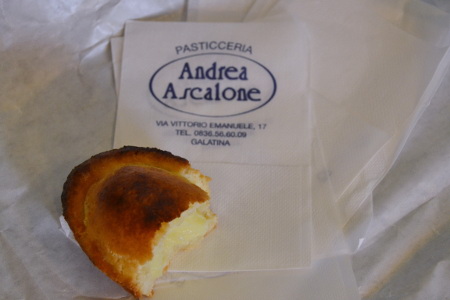
So you may think that the same product, more or less unchanged, it arrived in Salento as bocconotto and from 1700 on, it was called ‘pasticciotto’, a hybrid form of pasticci-no + boccon-otto. And this even before the invention of the recipe occurred later. In fact, between history and legend, it is said that the version that we are enjoying today is due to Andrea Ascalone that in 1745, he thought of a recipe for cake that could attract a large number of people during the feast of the patron saint. Between a test and another, he found himself a dough and some cream insufficient to bake a cake. He decided to use them equally by placing them in small copper forms: thus was born the “pasticciotto” today delight of pastry Ascalone in Galatina. Despite last summer has disappeared its holder, pasticciotti continue to be baked according to the original recipe that provides for the kneaded pastry with lard and not with butter. You come up with your mouth water? You just have to taste it!

